Making water use in global trade more sustainable
Making water use in global trade more sustainable examines how water, often treated as the “forgotten input” in global trade, remains largely invisible in supply-chain decisions despite being critical to the production, processing and transport of goods. The paper explores how trade can indirectly drive water depletion and degradation in water-stressed and economically vulnerable producer […]
Towards collective action for water stewardship in Malawi: lessons from emerging practice
This working paper explores how collective action for water stewardship is beginning to take shape in Malawi, where water security is critical to economic development and shared pressure on water resources is creating a need for more coordinated responses. Drawing on insights from the Fair Water Footprints Water Stewardship Masterclass and stakeholder interviews, the paper […]
Learning in complexity: insights from Fair Water Footprints
This working paper presents a learning stocktake from the early phase of the Fair Water Footprints initiative, a multistakeholder partnership working to make water use in global supply chains fairer and more sustainable. Drawing on two years of implementation, research and engagement, the paper explores how change is beginning to emerge in practice. It highlights […]
The water footprints of global food and agriculture trade
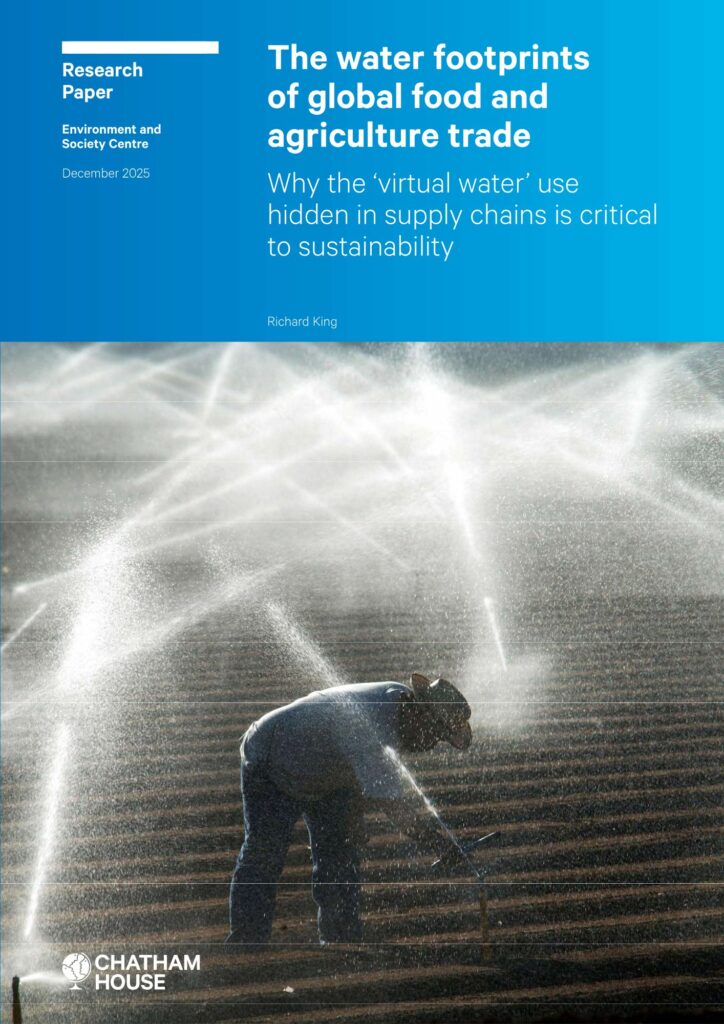
Chatham House research explains why the ‘virtual water’ use hidden in supply chains is critical to sustainability. When food and agricultural products are traded internationally, the direct and indirect water use associated with that trade results in a ‘water footprint’ – reflecting not only the freshwater needed to grow a crop, for instance, but also […]
Tackling trade-related water risks
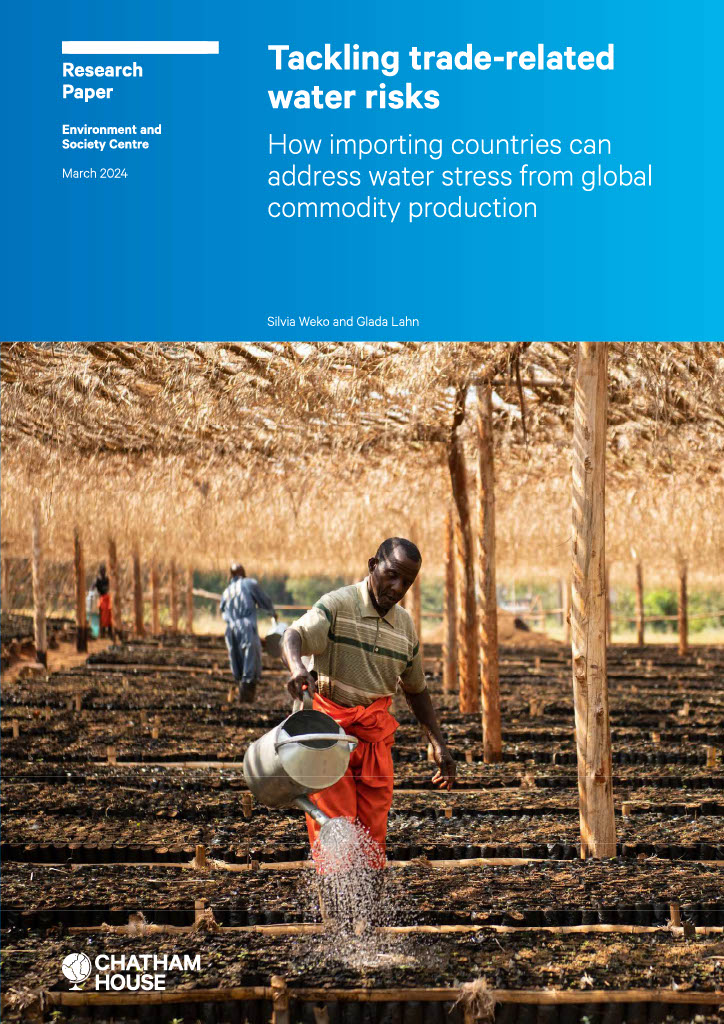
Chatham House research outlines how importing countries can address water stress from global commodity production. A combination of climate change impacts and the production of water-intensive commodities, such as food, textiles and minerals, is exacerbating global water insecurity. Around 50 per cent of the water used to produce goods imported into the Global North comes […]
Stewardship at the source, CDP Global Water Report
Global supply chains are increasingly complex and fragile, vulnerable to climate change, geopolitical disruption, and unsustainable practices—particularly around water use. Building resilience against extreme weather and reducing environmental impacts are now critical. While responsible companies are using tools like financial incentives and closer engagement, voluntary action alone is insufficient. Stronger regulation, mandatory disclosure, and coordinated […]
Towards Fair Water Footprints: Understanding the water footprints of the Global North and dependency on water use in the Global South
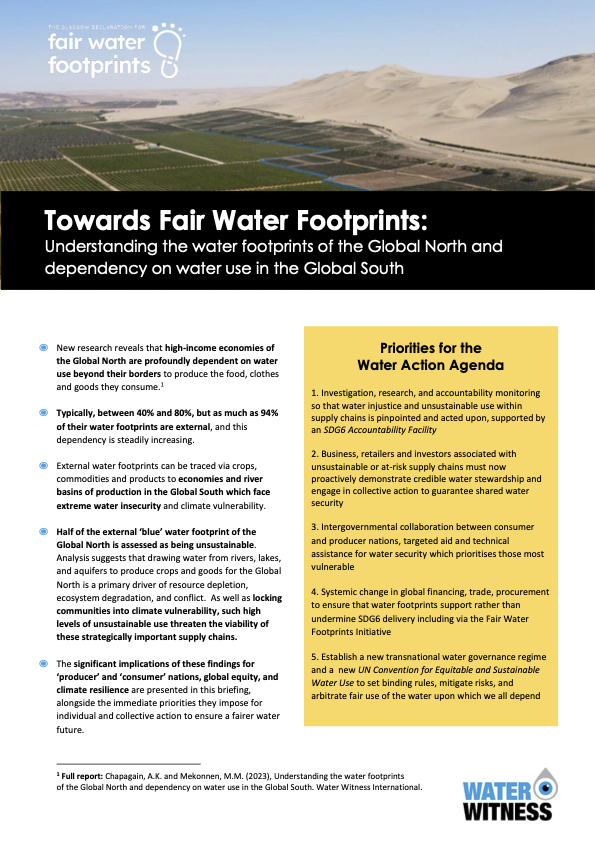
This paper highlights the profound external water dependency of high-income countries, with 40–94% of their water footprints sourced from outside their borders. These external footprints are heavily concentrated in regions facing high water and climate vulnerability. Critically, half of the Global North’s external ‘blue’ water footprint is unsustainable, contributing to environmental degradation, resource depletion, and […]
Fair Water Footprint stakeholder mapping
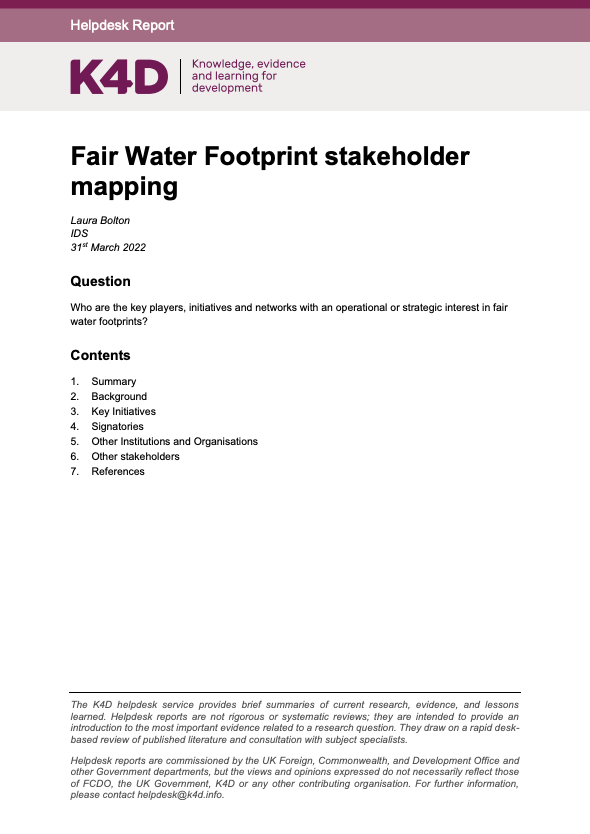
Commissioned by FCDO and the Declaration for Fair Water Footprints, this rapid review by K4D provides a stakeholder mapping of key players, initiatives, and networks with an operational or strategic interest in fair water footprints.
Triggering market transformation for fair water footprints
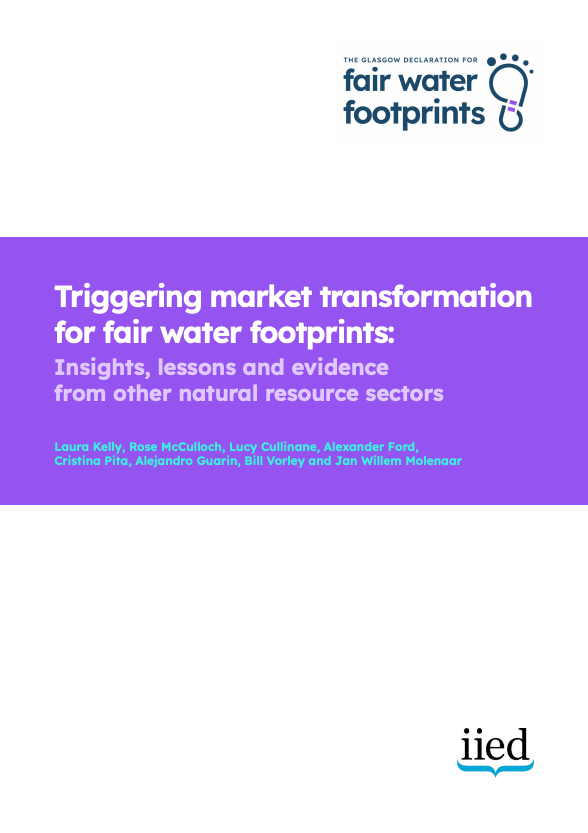
Insights, lessons and evidence of market transformation from other natural resource sectors, commissioned to inform the development of the Fair Water Footprint (FWF) approach.
How Fair is Fashion’s Water Footprint?
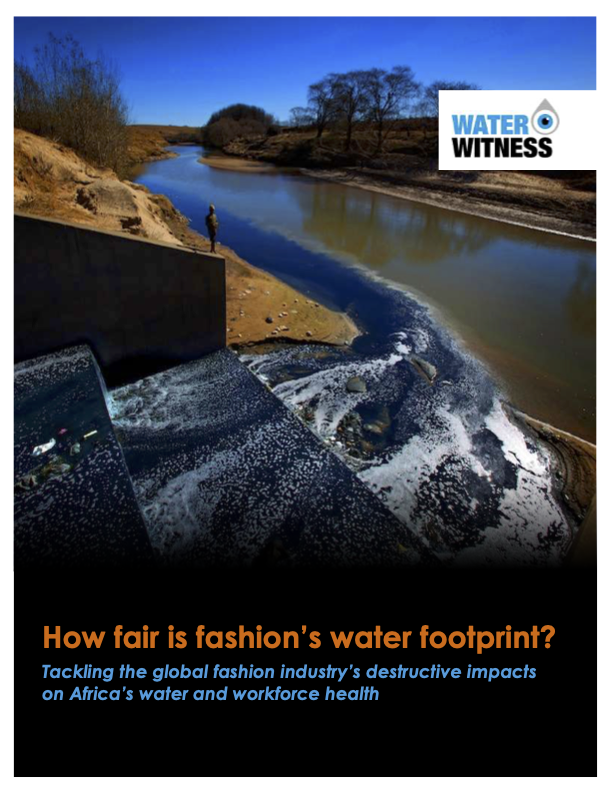
Evidence from Africa (where apparel production for export grows rapidly) – Tanzania, Ethiopia, Lesotho, Madagascar, Mauritius, suggests that production for household brands/supermarkets is associated with uncontrolled pollution; lack of WASH access; inequitable water access and pollution/scarcity in cotton production.